
Wood Shaving Machine vs Wood Chipper: Which is Better for Animal Bedding?
Choosing the right wood processing equipment for animal bedding can significantly impact your livestock operation’s comfort, hygiene, and overall profitability. When it comes to producing wood-based bedding materials, two machines dominate the market: the wood shaving machine and the wood chipper. But which one is right for your specific needs?
Both machines process raw wood materials, but they produce fundamentally different outputs with distinct characteristics. Wood shaving machines create thin, curled shavings ideal for poultry, horses, and small animals, while wood chippers produce chunkier wood chips better suited for outdoor applications, composting, or as a base layer in large animal enclosures.
This comprehensive comparison will break down everything you need to know about these two essential wood processing machines. We’ll examine their working principles, output characteristics, performance metrics, and ideal applications to help you make an informed investment decision for your animal bedding operation.
What is a Wood Shaving Machine?
Working Principle
A wood shaving machine operates through a precision cutting process that transforms logs, branches, and scrap wood into thin, uniform shavings. The machine features a rotating cutter head equipped with adjustable blades that slice wood material at high speed.
Here’s how it works: when you feed wood into the machine’s inlet, the rotating cutter head immediately engages the material. The blades, which can be adjusted to produce shavings between 0.5-3mm thickness, slice through the wood fibers, creating thin, curled strips. These shavings are then discharged through an outlet, ready for collection or direct application as animal bedding.
The key feature of wood shaving machines is their ability to produce consistent, fluffy shavings with high absorbency. The cutting action preserves the wood’s natural fibrous structure, creating millions of tiny air pockets that trap moisture while maintaining a soft, comfortable surface for animals.

Product Form: Wood Shavings
The output from a wood shaving machine is characterized by:
- Thin, curled strips: Typically 0.5-3mm thick, 10-50mm wide, and 20-100mm long
- Fluffy texture: Light, airy consistency that compresses under weight but rebounds
- High surface area: Maximum contact area for moisture absorption
- Uniform size: Consistent dimensions ensure even bedding coverage
- Low density: Approximately 80-120 kg/m³ when loosely packed
Advantages for Animal Bedding
Wood shaving machines offer several compelling benefits for bedding production:
- Superior absorbency: The thin, fibrous structure can absorb 3-5 times its weight in moisture, keeping animal enclosures dry and hygienic
- Excellent comfort: Soft, cushioned surface reduces pressure points and provides thermal insulation
- Odor control: High absorbency and air circulation help minimize ammonia buildup from urine
- Easy to manage: Spent bedding can be easily removed and replaced; clean shavings mix well with compost
- Versatile applications: Suitable for horses, chickens, pigs, rabbits, cattle, sheep, and pets
- Adjustable thickness: Cutter head can be tuned to produce shavings optimized for different animal types
Technical Specifications
Shuliy wood shaving machines are available in multiple models to match various production scales:
| Model | Capacity | Max Input Diameter | Power | Shaving Thickness |
|---|---|---|---|---|
| SL-420 | 300 kg/h | 6 cm | 7.5 kW | 0.5-3 mm |
| SL-600 | 500 kg/h | 12 cm | 15 kW | 0.5-3 mm |
| SL-800 | 1000 kg/h | 16 cm | 30 kW | 0.5-3 mm |
| SL-1000 | 1500 kg/h | 20 cm | 55 kW | 0.5-3 mm |
| SL-1200 | 2000 kg/h | 24 cm | 55 kW | 0.5-3 mm |
| SL-1500 | 2500 kg/h | 32 cm | 75 kW | 0.5-3 mm |
Both electric and diesel-powered units are available, with wheeled configurations for mobile operations. The machines can process logs, branches, poplar, mulberry, locust wood, shrubs, and scrap wood from building templates.
Ideal Animal Applications
Wood shavings are the preferred bedding choice for:
- Equestrian facilities: Horse stalls benefit from the soft, absorbent surface that protects hooves and reduces respiratory issues
- Poultry farms: Chicken coops require dry, hygienic bedding to prevent footpad dermatitis and maintain egg quality
- Pig farming: Piglets and finishing pigs need comfortable, warm bedding that absorbs waste effectively
- Rabbit hutches: Small animals require soft, dust-controlled bedding to protect sensitive respiratory systems
- Cattle and sheep: Barn bedding with wood shavings improves hygiene and animal comfort during winter months
- Pet bedding: Small pets like guinea pigs, hamsters, and birds benefit from clean, odor-controlling shavings

What is a Wood Chipper?
Working Principle
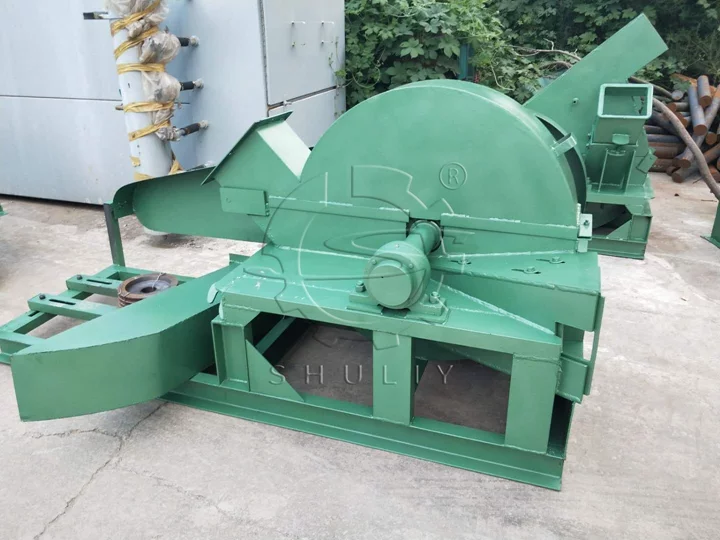
A wood chipper operates using a completely different mechanism compared to a wood shaving machine. It features a rotating disc or drum equipped with hardened steel knives that chip wood material into small, irregular pieces through impact cutting.
The process works like this: wood material is fed into the chipper’s inlet, where hydraulic or gravity-fed rollers guide it toward the cutting chamber. The rotating disc (in disc chippers) or drum (in drum chippers) spins at high speed, and the mounted knives strike the wood, breaking it into small chips. These chips are then propelled through a discharge chute by centrifugal force, often directly into a collection container or onto a conveyor belt.
The key characteristic of wood chippers is their impact-based cutting action, which produces chunky, irregular wood chips rather than thin shavings. The chip size is determined by the knife configuration, screen size (if equipped), and feed rate.
Product Form: Wood Chips
Wood chips produced by chippers have these characteristics:
- Chunky, irregular pieces: Typically 2-5 cm in length and width, 5-15mm thick
- Dense structure: Compact particles with limited air pockets
- Variable size distribution: Mix of small and large chips depending on screen configuration
- Rough texture: Sharp edges and uneven surfaces from impact cutting
- High density: Approximately 250-400 kg/m³ when loosely packed
Advantages for Specific Applications
While wood chips are less common for indoor animal bedding, they excel in other scenarios:
- High durability: Chips decompose slowly, making them ideal for long-term outdoor applications
- Excellent drainage: Large particle size allows water to flow through quickly, preventing waterlogging
- Weed suppression: Thick chip layers block sunlight and prevent weed growth in landscaping
- Cost-effective: Higher production capacity and lower energy consumption per ton compared to shavings
- Versatile feedstock: Can process larger diameter logs (up to 400mm) and mixed wood waste
- Composting base: Carbon-rich chips provide excellent structure for composting animal manure
Technical Specifications
Disc wood chippers are available in various capacities for different operation scales:
| Model | Capacity | Max Input Diameter | Chip Size | Power |
|---|---|---|---|---|
| WD-420 | 500 kg/h | 150 mm | 2-5 cm | 11 kW |
| WD-600 | 1500 kg/h | 180 mm | 2-5 cm | 18.5 kW |
| WD-800 | 3000 kg/h | 200 mm | 2-5 cm | 30 kW |
| WD-950 | 4000 kg/h | 230 mm | 2-5 cm | 37 kW |
| WD-1200 | 5000 kg/h | 330 mm | 2-5 cm | 55 kW |
| WD-1400 | 7000-8000 kg/h | 400 mm | 2-5 cm | 90 kW |
Drum wood chippers offer even higher capacity for industrial operations, with models like the SL-218 producing 10-15 tons per hour and accepting logs up to 300mm diameter. Both disc and drum chippers can be configured for stationary installation or mobile operation with towable frames.
Ideal Applications
Wood chips are best suited for:
- Biomass fuel: Power plants and heating facilities use wood chips as renewable energy source
- Paper manufacturing: Uniform chips are ideal for pulping processes
- Landscaping mulch: Chip layers suppress weeds, retain soil moisture, and improve aesthetics
- Composting: Chips provide carbon balance and structure for composting animal manure
- Pathway surfacing: Playgrounds, walking trails, and animal exercise areas
- Base layer bedding: Large animal enclosures can use chips as a drainage base topped with shavings
Wood Shaving Machine vs Wood Chipper: Detailed Comparison
To help you make an informed decision, let’s examine the key differences between wood shaving machines and wood chippers across multiple critical dimensions for animal bedding applications:
| Comparison Factor | Wood Shaving Machine | Wood Chipper |
|---|---|---|
| Working Principle | Precision cutting with adjustable blades (0.5-3mm thickness) | Impact cutting with rotating disc/drum and fixed knives |
| Product Form | Thin, curled shavings (fluffy, fibrous strips) | Chunky wood chips (irregular, dense pieces) |
| Product Size | 0.5-3mm thick, 10-50mm wide, 20-100mm long | 2-5cm length/width, 5-15mm thick |
| Absorbency | Excellent (absorbs 3-5× its weight in moisture) | Moderate (absorbs 1-2× its weight in moisture) |
| Comfort Level | Superior (soft, cushioned surface for animals) | Basic (firm, uneven surface not ideal for direct contact) |
| Production Capacity | 300-2,500 kg/h depending on model | 500-8,000 kg/h (disc); 5-15 t/h (drum) |
| Energy Consumption | Moderate (7.5-75 kW depending on model) | Lower per ton (11-90 kW with higher output) |
| Raw Material Size | Up to 320mm diameter (SL-1500) | Up to 400mm diameter (WD-1400) |
| Product Density | Low (80-120 kg/m³ loosely packed) | High (250-400 kg/m³ loosely packed) |
| Best For | Indoor animal bedding (poultry, horses, pigs, rabbits) | Outdoor applications, biomass fuel, composting, base layers |
| Initial Investment | Moderate (specialized for bedding production) | Lower to moderate (versatile for multiple applications) |
| Operating Cost | Moderate (higher energy per ton, premium product value) | Lower (better energy efficiency, higher volume) |
| Maintenance | Regular blade sharpening (every 40-80 hours) | Knife rotation/replacement (every 80-120 hours) |
| Market Value | Higher (premium bedding material for animal farms) | Lower (commodity product for biomass/landscaping) |
Absorbency and Moisture Management
For animal bedding, moisture absorption is arguably the most critical factor. Wood shavings produced by shaving machines have a significant advantage due to their thin, fibrous structure with millions of tiny air pockets. According to animal bedding research, high-quality wood shavings can absorb 3-5 times their weight in moisture, compared to 1-2 times for wood chips.
This superior absorbency translates to:
- Drier animal enclosures with reduced ammonia levels
- Less frequent bedding changes (lower labor costs)
- Better animal health and reduced disease transmission
- Improved product quality for bedding suppliers
Animal Comfort and Welfare
Animal comfort directly impacts productivity, growth rates, and overall welfare. Wood shavings provide a soft, cushioned surface that:
- Reduces pressure sores and hock burns in poultry
- Protects horse hooves and joints during prolonged standing
- Provides thermal insulation in cold weather
- Encourages natural behaviors like nesting and foraging
- Minimizes stress and injury risk
Wood chips, with their chunky, irregular structure, are too firm and uneven for most indoor animal bedding applications. They may be suitable as a base layer in large outdoor enclosures but should be topped with softer material for animal comfort.
Production Efficiency and Costs
When comparing production efficiency, wood chippers have an advantage in raw throughput. A large disc chipper like the WD-1400 can process 7,000-8,000 kg/h, while the largest wood shaving machine (SL-1500) produces 2,500 kg/h. However, this comparison doesn’t tell the whole story.
The key metric is value per ton. Wood shavings for animal bedding command a premium price ($80-150/ton depending on quality and region) compared to wood chips for biomass or landscaping ($30-60/ton). This means a wood shaving machine operating at 2,500 kg/h can generate comparable or higher revenue than a chipper running at 8,000 kg/h.
Energy Consumption Analysis
Energy efficiency is an important operational cost factor. Per ton of output, wood chippers generally consume less energy due to their impact-based cutting mechanism and higher throughput. However, wood shaving machines operate at moderate power levels (7.5-75 kW) and produce a higher-value product that offsets the energy cost difference.
For operations focused specifically on animal bedding production, the slightly higher energy cost of wood shaving machines is justified by the superior product quality and market value.
How to Choose: Wood Shaving Machine or Wood Chipper?
Selecting between a wood shaving machine and a wood chipper depends on several critical factors. Here’s a comprehensive decision framework to guide your investment:
Choose Based on Primary Application
- Choose a Wood Shaving Machine if:
- Your primary goal is producing animal bedding for poultry, horses, pigs, rabbits, or pets
- You need high-absorbency, comfortable bedding material
- You’re targeting premium bedding markets with higher profit margins
- Animal welfare and comfort are top priorities
- Choose a Wood Chipper if:
- You need wood chips for biomass fuel, paper manufacturing, or landscaping
- You want to produce a base layer for large animal enclosures
- You’re focused on high-volume processing with lower unit margins
- You need versatile equipment for multiple wood processing applications
Choose Based on Raw Materials
- Wood Shaving Machine: Best for logs, branches, and scrap wood up to 320mm diameter. Works well with poplar, pine, and other softwoods that produce fluffy shavings. Peeled logs yield the highest quality shavings with minimal debris.
- Wood Chipper: More versatile for mixed feedstock including large logs up to 400mm, branches, wood waste, and even contaminated materials (for biomass applications). Handles hardwoods and softwoods equally well.
Choose Based on Production Scale
- Wood Shaving Machine: Ideal for 300-2,500 kg/h production scales. Perfect for dedicated bedding suppliers, large farms producing their own bedding, or regional distributors serving multiple animal operations.
- Wood Chipper: Suitable for 500-8,000 kg/h (disc) or 5-15 t/h (drum) operations. Best for large-scale biomass facilities, paper mills, landscaping companies, or wood recycling centers.
Choose Based on Budget and ROI
- Wood Shaving Machine: Moderate initial investment with strong ROI through premium product pricing. Typical payback period: 12-18 months for well-managed bedding operations. Higher operating costs offset by higher product value.
- Wood Chipper: Lower to moderate initial investment with ROI driven by volume efficiency. Typical payback period: 8-14 months for high-volume operations. Lower operating costs but commodity pricing.
Hybrid Approach: Using Both Machines
For large-scale animal farming operations or integrated wood processing facilities, using both machines can be optimal:
- Base layer: Use wood chips from a chipper as a drainage base in large animal enclosures
- Top layer: Use wood shavings from a shaving machine as the comfortable, absorbent top layer
- Composting: Use wood chips for composting manure and spent bedding, creating valuable fertilizer
- Energy production: Use wood chips as biomass fuel for on-site heating or power generation
This hybrid approach maximizes the strengths of both machines while optimizing overall operational efficiency and sustainability.

Frequently Asked Questions (FAQ)
1. Can wood chips be used directly as animal bedding?
Wood chips are generally not recommended as direct animal bedding for indoor applications due to their chunky, firm texture. They lack the softness and absorbency needed for animal comfort and hygiene. However, wood chips can serve as an effective base layer in large outdoor enclosures or barns, topped with 2-4 inches of wood shavings for comfort. Some large animal operations (like cattle feedlots) may use chips alone, but this requires more frequent maintenance and may impact animal welfare.
2. Which machine is better for a small poultry farm (500-1000 chickens)?
For a small poultry farm with 500-1000 chickens, a wood shaving machine is the clear choice. The SL-420 or SL-600 model (300-500 kg/h capacity) would be sufficient to produce high-quality bedding with the absorbency and comfort needed for poultry health. Wood shavings help prevent footpad dermatitis, reduce ammonia levels, and maintain dry litter conditions critical for egg production and bird welfare. A typical flock of 1000 broiler chickens requires approximately 200-300 kg of bedding per cycle, which a small shaving machine can produce in less than one hour of operation.
3. How often do the blades need to be replaced or sharpened?
Blade maintenance frequency depends on material hardness, contamination levels, and operating hours. For wood shaving machines, blades should be inspected every 40-80 operating hours and sharpened when shaving quality deteriorates (uneven thickness, rough edges). Blades typically last 200-400 hours before requiring replacement. For wood chippers, knives can operate 80-120 hours between rotations or sharpening, with total lifespan of 400-600 hours. Regular maintenance ensures consistent product quality and prevents excessive wear on other machine components.
4. Can these machines process wet or green wood?
Both machines can process wood with varying moisture content, but there are important considerations. Wood shaving machines perform best with seasoned wood (moisture content 15-25%). Green or very wet wood (40%+ moisture) can produce clumpy shavings that don’t fluff properly and may clog the machine. Wood chippers are more tolerant of green wood and can process freshly cut logs effectively, though wet chips require drying before use as bedding or biomass fuel. For optimal bedding quality, it’s recommended to use partially seasoned wood and allow produced shavings to air-dry before packaging or application.
5. What’s the typical ROI for a wood shaving machine in the animal bedding business?
ROI for a wood shaving machine in the animal bedding business varies based on scale, market conditions, and operational efficiency. For a medium-sized operation (SL-800 model, 1000 kg/h capacity) running 8 hours/day, 5 days/week:
- Weekly production: 40,000 kg (40 tons)
- Revenue: At $100/ton average price = $4,000/week
- Operating costs: Energy, labor, maintenance ≈ $1,500-2,000/week
- Gross profit: $2,000-2,500/week
- Payback period: 12-18 months for equipment investment
Actual ROI depends on local bedding prices, raw material costs, labor rates, and market demand. Operations in regions with high livestock density and limited bedding supply typically see faster payback periods.
Conclusion: Making the Right Choice for Animal Bedding
When it comes to producing animal bedding, the wood shaving machine is the clear winner for most applications. Its ability to produce thin, fluffy, highly absorbent shavings makes it ideal for poultry, horses, pigs, rabbits, and other livestock that require comfortable, hygienic bedding. The superior moisture management, animal comfort, and premium market value justify the moderate investment and operating costs.
Wood chippers, while excellent for biomass fuel, paper manufacturing, landscaping, and composting, produce wood chips that are too coarse and firm for direct use as indoor animal bedding. However, they can play a complementary role in integrated operations by providing base layers, composting materials, or biomass fuel for on-site energy production.
The bottom line: if your primary goal is producing high-quality animal bedding, invest in a wood shaving machine. If you need versatile wood processing for multiple applications including some bedding production, consider a wood chipper with the understanding that chips may need to be blended with shavings or used only for specific applications.
Ready to Start Producing Premium Animal Bedding?
Shuliy wood shaving machines are trusted by farms and bedding producers worldwide, with successful installations in the USA, South Africa, Australia, UAE, and 50+ other countries. Our machines combine precision engineering, durable construction, and adjustable settings to produce the highest quality wood shavings for animal bedding.
Need personalized advice? Our wood processing specialists can help you select the perfect machine for your animal bedding operation. Contact us at woodmachine.org for expert guidance and competitive pricing.
Related Resources:
- Wood Shaving Machine for Animal Bedding – Complete product specifications and applications
- Disc Wood Chipper – High-efficiency wood chipping for biomass and paper industry
- Drum Wood Chipper – Large-scale continuous wood chip production
- Applications of Wood Shavings – Comprehensive guide to wood shavings uses beyond animal bedding
- Which Wood Shavings are Best for Chicken Farms? – Expert guide for poultry bedding selection
- Wood Shaving Machine Price Guide – Cost analysis and buying guide